Leucine Rich Foods: The Science of Muscle Protein Synthesis for Naperville Adults
What if the primary reason for your fitness plateau isn’t how hard you’re training, but a biological “light switch” that remains stuck in the off position? Many Naperville adults over 40 find that recovery takes longer and maintaining muscle mass feels increasingly difficult, despite consistent effort in the gym. It’s a common frustration to see minimal changes in body composition while following generic nutritional advice that no longer serves your changing physiology.
You deserve a strategy rooted in clinical precision rather than guesswork. This article explains why leucine rich foods are the essential metabolic trigger needed to overcome anabolic resistance and maximize muscle protein synthesis. You will learn the exact science behind the updated 2026 protein guidelines and discover how to source high-quality, local ingredients to fuel your transformation at Body by Raven LLC.
We’ll provide a comprehensive breakdown of the best leucine sources, compare the efficiency of animal versus plant proteins, and offer a specific Naperville shopping guide. By the end, you’ll have a clear, actionable roadmap to faster recovery and improved strength.
Key Takeaways
- Understand the role of the mTOR pathway as your body’s primary biological sensor for signaling muscle growth and repair.
- Identify the most efficient leucine rich foods, ranging from lean animal proteins to plant-based leaders like soy and pumpkin seeds.
- Learn why whole-food protein sources outperform isolated BCAA supplements by providing the essential amino acid “supporting cast” your body requires.
- Navigate Naperville markets with a targeted shopping list for sourcing high-quality, grass-fed, and pasture-raised proteins locally.
- Discover how Body by Raven LLC integrates personalized nutrition with mechanical tension to effectively overcome anabolic resistance after 40.
Table of Contents
- The Leucine Trigger: Why This Amino Acid is Essential for Naperville Fitness After 40
- High-Leucine Food Sources: Comparing Animal and Plant-Based Proteins
- Whole Foods vs. BCAAs: Why Your Body Prefers Real Nutrition
- The Naperville Leucine Shopping Guide: Where to Find Quality Protein Locally
- Beyond the Plate: How Private Coaching at Body by Raven Optimizes Your Results
The Leucine Trigger: Why This Amino Acid is Essential for Naperville Fitness After 40
Most individuals assume that hitting a total protein goal is the only requirement for maintaining a lean, functional physique. However, your body doesn’t just count grams; it looks for specific biochemical signals. What is Leucine? Scientifically, it’s the primary branched-chain amino acid (BCAA) that dictates whether your body enters an anabolic, or muscle-building, state. It acts as the essential “on” switch for your metabolism. You can think of the mTOR pathway as your body’s “anabolic sensor.” When you consume leucine rich foods, this sensor detects the amino acid and signals the machinery inside your cells to start repairing and building muscle tissue. Without reaching a specific concentration of leucine in the blood, that sensor remains dormant, regardless of how many calories you eat.
Anabolic Resistance and the Aging Muscle
Naperville residents over 40 face a unique physiological challenge that younger athletes don’t encounter. While we touched on the efficiency gap in the introduction, it’s vital to understand the root cause. This phenomenon is why you might feel like you’re working harder in the gym but seeing fewer results. Insufficient leucine intake leads to progressive muscle wasting because the signal to build isn’t strong enough to overcome the natural breakdown of tissue. Anabolic resistance is the decreased sensitivity of muscle tissue to protein intake. To combat this, you must prioritize specific nutrient density over sheer volume to ensure your body actually utilizes the protein you provide.
Leucine vs. Total Protein: Quality Over Quantity
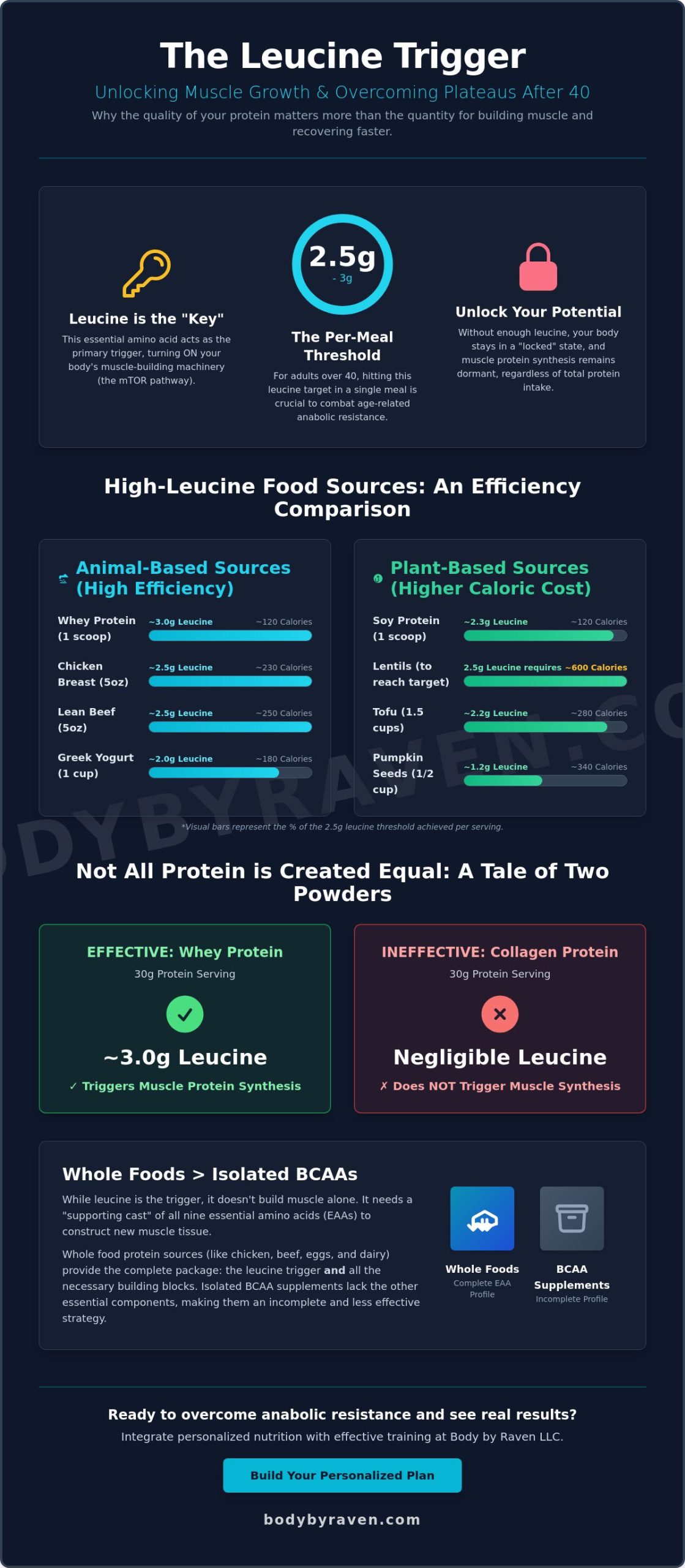
Simply “counting macros” is often where body transformations stall. Not all proteins are created equal. For example, 30 grams of collagen protein contains a negligible amount of leucine, while 30 grams of high-quality whey protein provides about 3 grams. One of these will trigger the mTOR pathway, while the other primarily supports connective tissue. This distinction is vital for post-rehabilitation recovery for Naperville athletes who need to regain strength after an injury. To effectively trigger muscle growth, you need to hit the threshold mentioned earlier. Choosing leucine rich foods ensures that every calorie you consume works toward your goal of fat loss and muscle preservation. It’s about precision, not just quantity.
High-Leucine Food Sources: Comparing Animal and Plant-Based Proteins
Identifying the most efficient leucine rich foods is the practical application of the threshold concept discussed earlier. For adults over 40, the goal is to hit that 2.5 to 3 gram target without consuming excessive calories that might stall fat loss. This requires a strategic look at protein density and bioavailability. While many foods contain amino acids, the concentration of leucine varies wildly between animal and plant sources. Selecting the most efficient delivery system is a cornerstone of personalized nutrition at Body by Raven LLC.
The Gold Standard: Dairy and Meat
Animal proteins are the most efficient way to trigger muscle protein synthesis because they are naturally high in branched-chain amino acids. Whey and casein dairy proteins are the most efficient leucine delivery systems available. A single scoop of high-quality whey isolate often contains the full 2.5 grams of leucine required to hit the threshold. When looking at whole foods, a 5oz portion of chicken breast provides approximately 2.5 grams of leucine, while 5oz of lean grass-fed beef offers a similar profile along with essential micronutrients like zinc and B12. Integrating grass-fed beef into a weight loss program provides the satiety and nutrient density necessary for long-term success in Naperville’s active population.
Plant-Based Leucine Strategies
Vegetarians and vegans can hit their targets, but it requires intentional planning to avoid overconsuming carbohydrates. Soy protein isolate stands out as the plant-based leader, offering a leucine profile that rivals some animal sources. However, whole-food plant sources like lentils and pumpkin seeds come with a higher “caloric cost.” To get 2.5 grams of leucine from lentils, you would need to consume nearly 600 calories worth of beans, compared to just 250 calories of lean beef. This is why many vegan athletes in Naperville rely on high-quality plant-based protein powders to bridge the gap. For a quick comparison, 100g of tempeh contains about 1.5 grams of leucine, whereas 100g of tofu provides only about 0.7 grams.
Bioavailability also plays a significant role in how your body processes these nutrients. Animal-based High-Leucine Foods are generally absorbed more efficiently by the human digestive tract. This doesn’t mean you must avoid plants; it means you should prioritize variety and perhaps higher total protein volumes if your diet is strictly plant-based. At Body by Raven LLC, we help you navigate these complexities to ensure your meal plan supports your specific body transformation goals.
Whole Foods vs. BCAAs: Why Your Body Prefers Real Nutrition
Can you simply take a pill to get the benefits of leucine? It’s a question many Naperville adults ask when faced with the discipline of meal planning. While the supplement industry markets branched-chain amino acids (BCAAs) as a shortcut to muscle growth, the clinical reality is more complex. Leucine acts as the spark for the metabolic engine, but it cannot build tissue in isolation. To sustain muscle protein synthesis, your body requires a complete “supporting cast” of all nine essential amino acids (EAAs). Without these building blocks present in the bloodstream, the signal triggered by leucine quickly fades, leaving your muscles in a state of stalled repair.
Whole food sources provide an insulinogenic effect that supplements often lack. When you consume leucine rich foods like Greek yogurt or lean steak, your body produces a controlled insulin response. This hormone isn’t just for blood sugar management; it acts as a powerful transport vehicle that drives amino acids directly into the muscle cells. Additionally, the complex structure of real food ensures a steady, prolonged release of nutrients. This sustained delivery is far more effective for long-term body transformation than the rapid, short-lived spike provided by an isolated capsule.
The Failure of Isolated BCAAs
Recent metabolic studies demonstrate that isolated leucine fails to maintain the muscle-building process over several hours. This follows the “all-or-nothing” principle of biology: if even one essential amino acid is missing, the body cannot create new protein structures. Isolated leucine supplementation without a full spectrum of essential amino acids is like turning the ignition on a car with no fuel in the tank. You get the noise of the engine starting, but you won’t get anywhere. Relying on pills often leads to wasted investment and disappointing physical results.
Metabolic Benefits of Whole Food Protein
Choosing whole leucine rich foods offers a significant metabolic advantage through the thermic effect of food (TEF). Your body burns approximately 20 to 30 percent of the calories found in protein just to digest and process it. This natural “metabolic tax” supports Naperville weight loss goals more effectively than liquid supplements. Furthermore, whole proteins are packed with critical micronutrients like Vitamin B12 and Zinc, which are essential for energy production and hormonal health. Dr. Raven Flores prioritizes Personalized Nutrition at Body By Raven ™ because real food provides the satiety and nutrient density required for a sustainable lifestyle change. If your wellness journey also involves reproductive health goals, you can check out ah! fertility nutrition for specialized nutritional therapy. We focus on high-quality fuel that keeps you full, focused, and physically capable as you age.
The Naperville Leucine Shopping Guide: Where to Find Quality Protein Locally
Applying the science of muscle protein synthesis requires a practical strategy at your local grocery store. Knowing how to identify and source leucine rich foods within the 60540 and 60563 zip codes makes the difference between a stalled metabolism and a successful body transformation. Naperville offers several high-end retailers and markets that prioritize the nutrient density required for fitness after 40. By choosing local, less-processed options, you ensure that the amino acid profiles remain intact and free from the inflammatory additives often found in mass-produced meats.
Local Sourcing for Maximum Nutrient Density
The Naperville Farmers Market is an invaluable resource for sourcing pasture-raised eggs and grass-fed beef. These local products often contain higher levels of omega-3 fatty acids and fat-soluble vitamins compared to conventional supermarket options. For those who prefer a traditional butcher experience, Casey’s Foods on Washington Street provides precision-cut lean meats that make hitting your leucine targets straightforward. Supporting these local artisanal shops does more than just boost the Naperville economy. It provides you with a superior “raw material” for muscle repair. When you know exactly where your protein comes from, you’re more likely to stay disciplined with your personalized nutrition plan.
A Sample “Leucine-Focused” Naperville Grocery List
Success starts in the kitchen. To hit the 2.5 gram leucine threshold per meal, your shopping cart should include a variety of dense protein sources. Use this list as your guide for your next trip to Whole Foods Naperville or Standard Market:
- Grass-Fed Lean Beef: Buy 1 lb for roughly three 5oz servings (2.5g leucine per serving).
- Pasture-Raised Eggs: You’ll need about 4 large eggs or a mix of whole eggs and whites to reach the threshold.
- Fage Total 0% Greek Yogurt: One 1 cup serving provides approximately 2.5g of leucine.
- Good Culture Cottage Cheese: Look for this at Casey’s Foods; 1 cup provides roughly 2.8g of leucine.
- Wild-Caught Sockeye Salmon: A 6oz fillet provides the leucine trigger plus anti-inflammatory fats.
- Organic Firm Tofu: Available at Standard Market; you’ll need about 1.5 cups to hit the target if you’re following a plant-based day.
Reading labels at DuPage County grocers is essential for quality control. Avoid “protein-enriched” snacks that rely on collagen or low-quality soy fillers, as these rarely provide the specific amino acid profile needed to overcome anabolic resistance. If you’re unsure how to integrate these items into your daily routine, our personalized nutrition coaching at Body By Raven ™ provides a custom roadmap tailored to your specific metabolic needs. We take the guesswork out of the grocery aisle so you can focus on your results.
Beyond the Plate: How Private Coaching at Body by Raven Optimizes Your Results
Consuming leucine rich foods provides the necessary chemical signal for muscle repair, but nutrition alone is only 50 percent of the equation. To effectively overcome the 16 percent decrease in muscle protein synthesis often seen in adults over 40, you must provide a physical reason for your body to utilize those amino acids. This is where mechanical tension comes in. Without the stimulus of structured resistance training, even the most precise intake of leucine rich foods won’t result in significant muscle growth. At Body By Raven ™, we ensure that your dietary discipline is matched by a scientifically backed training program designed specifically for the physiological needs of the aging body.
How do you know if your new nutritional habits are actually working? We use advanced body composition analysis to track your progress with clinical precision. This goes far beyond the number on a scale. We measure lean muscle mass, fat percentage, and metabolic rate to verify that your protein intake is building tissue rather than just being oxidized for energy. Moving from informational reading to a personalized transformation plan requires this level of data-driven oversight. It’s the difference between guessing and knowing that your metabolic health is improving.
Kinesiology and Nutrition: A Synergistic Approach
Dr. Raven Flores utilizes a deep understanding of kinesiology to maximize how your body processes nutrients. By aligning your training sessions with your peak protein absorption windows, we create a synergistic effect that speeds up recovery and improves body composition. Our private, one-on-one sessions ensure that your form is perfect and your intensity is optimized for metabolic health. If you’re ready for professional guidance, contacting a private personal trainer Naperville is the most effective way to bridge the gap between theory and results.
Taking the First Step Toward Transformation
Your journey begins with a comprehensive nutrition and body composition analysis. During this initial meeting, we strip away the confusion of generic diet trends and replace them with a bespoke roadmap. We design personalized meal plans that remove the guesswork from leucine targeting, ensuring you hit that 2.5 to 3 gram threshold at every meal. This professional partnership provides the accountability and expertise needed for long-term sustainability. Don’t leave your health to chance. Schedule your private training and nutrition consultation in Naperville today and take the first step toward a stronger, leaner future.
Take Command of Your Metabolic Health Today
You now understand that overcoming anabolic resistance after 40 requires more than just generic protein intake. By reaching the 2.5 gram threshold through leucine rich foods, you provide your body with the clinical signal it needs to rebuild and recover. Whether you’re sourcing pasture-raised eggs from the Naperville Farmers Market or lean beef from Casey’s Foods, the quality of your fuel dictates the speed of your transformation. Science shows that nutrition only reaches its full potential when paired with precise, mechanical tension through resistance training.
Dr. Raven Flores, Ph.D., specializes in helping adults navigate these complexities in an exclusive private studio environment. Our programs are specifically designed for fitness after 40 and post-rehab recovery, ensuring every effort you make in the kitchen and the gym is optimized for your unique physiology. It’s time to move beyond guesswork and embrace a professionalized methodology. You deserve a plan that respects the science of aging while delivering the results you’ve worked for.
Book Your PhD-Led Nutrition & Training Consultation in Naperville
Frequently Asked Questions
How much leucine do I need per day to lose weight and keep muscle?
You should aim for 2.2 to 3.0 grams of leucine per meal to effectively trigger muscle protein synthesis. For an adult following the 2026 USDA guideline of 1.2 to 1.6 grams of protein per kilogram of body weight, this usually translates to three or four leucine-focused meals daily. This structured approach ensures you maintain lean mass while achieving a caloric deficit for sustainable weight loss. To understand exactly how much protein to eat to lose weight using the updated 2026 clinical calculations, our Ph.D.-led guide provides a precise, personalized breakdown for adults over 40.
Is there a risk of eating too much leucine?
There is no established upper limit for leucine from whole food sources in healthy adults. However, relying on excessive isolated supplements can potentially lead to an imbalance in other branched-chain amino acids. It’s best to prioritize leucine rich foods to ensure you receive a balanced spectrum of nutrients without the metabolic stress of over-supplementation or digestive upset during your transformation.
Can I get enough leucine from a vegetarian diet in Naperville?
You can certainly meet your requirements on a vegetarian diet by prioritizing high-density sources like soy protein isolate and pumpkin seeds. Since plant proteins are roughly 10 to 20 percent lower in leucine than animal sources, you may need to increase your portion sizes slightly. Local retailers like Standard Market in Naperville offer various whole-food plant proteins that support these specific nutritional goals.
What are the best leucine-rich snacks for busy professionals?
The most convenient options for professionals include Greek yogurt, cottage cheese, and pumpkin seeds. A single cup of Greek yogurt from a local Naperville grocer provides about 2.5 grams of leucine, making it an ideal mid-day snack. These portable leucine rich foods provide the satiety needed to avoid office cravings while supporting your muscle health and recovery throughout the busy workday.
Does cooking affect the leucine content of meat or eggs?
Standard cooking methods like grilling, roasting, or boiling don’t significantly reduce the leucine content of your food. Amino acids are quite resilient to heat. You should avoid extreme overcooking or charring, as these processes can create inflammatory compounds. These compounds may interfere with your body’s overall nutrient absorption and the long-term recovery goals we set at Body By Raven ™.
How soon after a workout at a Naperville gym should I eat leucine-rich foods?
Aim to consume your protein within 45 to 60 minutes of finishing your training session to maximize the muscle-building signal. While your total daily intake is the most important factor, this post-workout window is a prime opportunity for your body to utilize nutrients. Getting a meal in soon after your session at a Naperville studio helps kickstart the repair process and stabilizes blood sugar.
What is the difference between leucine and other amino acids like valine or isoleucine?
Leucine is unique because it serves as the primary metabolic trigger for muscle growth, whereas valine and isoleucine play supporting roles in energy production and tissue repair. While all three are branched-chain amino acids, leucine is the only one capable of independently signaling the mTOR pathway. You need all three for optimal health, but leucine is the non-negotiable leader for body transformation.








Leave a Reply