Weight Loss vs. Fat Loss: A Naperville Trainer’s Guide
Have you ever worked tirelessly for weeks only to feel frustrated when the scale barely budges, even though your clothes fit differently? It’s a common source of anxiety for many in Naperville, but it highlights the critical distinction of weight loss versus fat loss. While total weight measures everything from bone density to water retention, fat loss focuses specifically on reducing adipose tissue while preserving the lean muscle that keeps your metabolism thriving.
You likely want more than just a lower number; you want to feel stronger, look leaner, and maintain your results for years to come. It’s easy to feel confused by “skinny fat” results that leave you feeling fatigued and depleted. This guide will show you why shifting your focus to body composition is the secret to metabolic longevity and mental clarity. We’ll explore how to prioritize muscle preservation, the latest 2026 health standards from the CDC and Department of Defense, and the precise nutritional strategies required to transform your physique without the scale induced stress.
Key Takeaways
- Understand why the distinction of weight loss versus fat loss is the foundation of a successful transformation that lasts a lifetime.
- Learn how to interpret body composition results so you can celebrate progress even when the scale remains stationary.
- Discover the metabolic risks of losing lean muscle and how to avoid the “rebound” effect that often follows traditional dieting.
- Identify the specific roles of protein, resistance training, and recovery in sculpting a leaner, more resilient physique.
- Gain insight into how clinical expertise and private, one-on-one coaching in Naperville provide the mental focus needed for a sustainable lifestyle change.
What is the Actual Difference Between Weight Loss and Fat Loss?
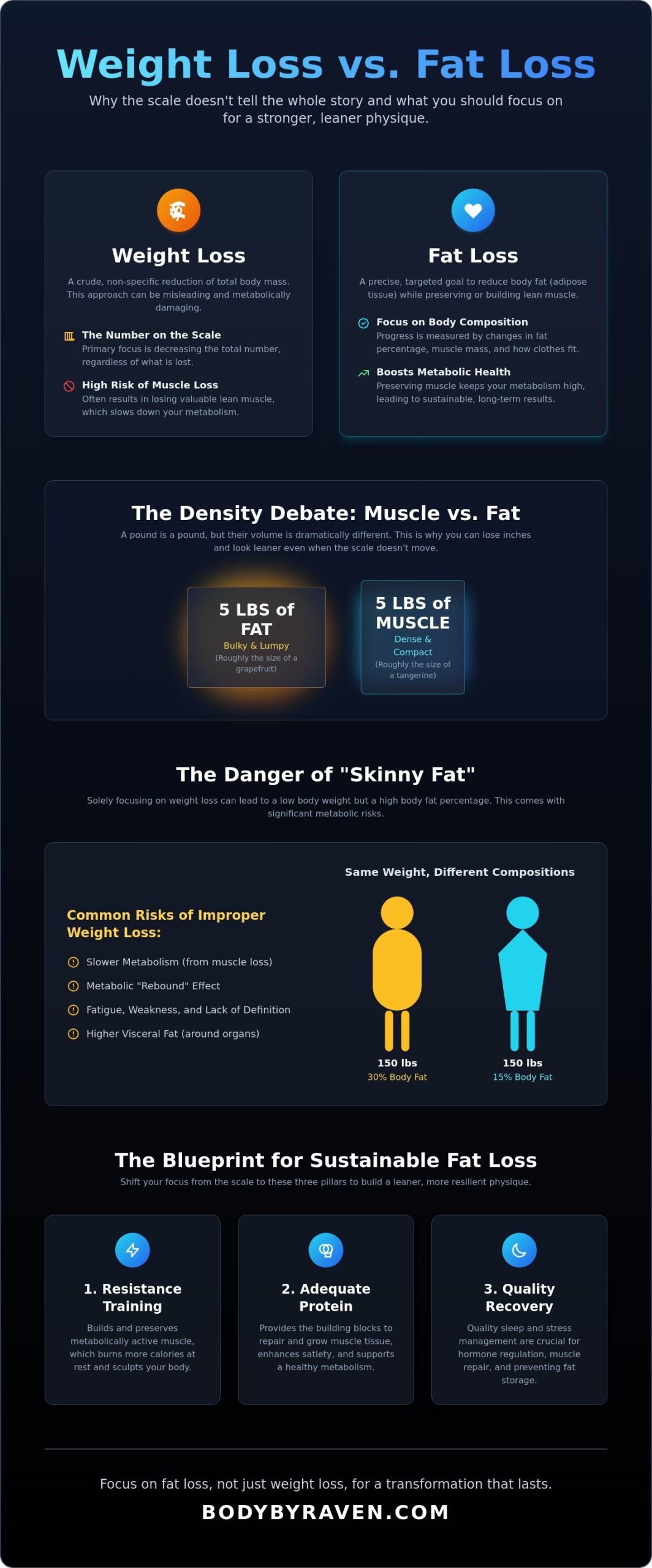
The scale is a blunt instrument. It provides a single number that represents your total mass, but it fails to distinguish between a pound of life-sustaining muscle and a pound of inflammatory adipose tissue. When we examine the nuances of weight loss versus fat loss, we see two entirely different biological outcomes. Weight loss is a crude reduction of total body mass. It includes everything from water and glycogen to bone density and muscle. If you focus solely on making that number smaller, you risk losing the very tissues that keep your metabolism running efficiently.
Fat loss is a precision objective. It specifically targets the reduction of adipose tissue while you work to preserve or even increase your lean muscle mass. Relying only on total weight often leads to the “skinny fat” phenomenon. This happens when a person reaches a lower weight but maintains a high body fat percentage. The result is a physique that lacks definition and a metabolism that has slowed down significantly because of muscle loss. Using Body Composition Analysis allows us to see past the scale and track what’s actually changing under the surface.
Understanding the Components of Total Body Weight
Your body weight is incredibly volatile. It’s not uncommon for a person to see a three pound shift in 24 hours simply due to changes in water retention or glycogen storage. These fluctuations don’t represent fat gain or loss. The Science of Body Composition explains that your weight is a sum of fat mass and fat-free mass, which includes your bones, organs, and connective tissues. While bone density and organ mass remain relatively stable, muscle is the most valuable “weight” you can carry. It serves as your primary metabolic engine, burning more energy at rest than any other tissue in your body.
Defining Fat Loss as a Metabolic Goal
Fat loss isn’t just about fitting into smaller clothes; it’s about optimizing your internal health. We are particularly concerned with visceral fat, the deep adipose tissue that surrounds your internal organs. High levels of visceral fat are linked to metabolic dysfunction and chronic inflammation. By reducing your body fat percentage rather than just your total pounds, you improve insulin sensitivity and support healthier hormonal balance. Fat loss is the selective reduction of adipose tissue to optimize metabolic health. This focused approach ensures that your transformation is sustainable and that you feel as strong as you look.
Why the Scale Lies: The Science of Body Composition
Relying on a standard bathroom scale as your primary measure of success is like trying to navigate a complex city with only a compass. It gives you a general direction, but it ignores the landmarks and terrain that define the journey. The fundamental confusion surrounding weight loss versus fat loss stems from this lack of detail. While the scale measures your relationship with gravity, it tells us nothing about your vitality, strength, or metabolic health. Stepping on the scale every morning often creates a psychological trap. These daily fluctuations are usually caused by water retention or inflammation rather than actual physical change, yet they can derail your long term focus and trigger unnecessary anxiety.
True progress is found in functional milestones. Can you carry groceries without fatigue? Do you feel more energetic throughout the afternoon? These are the indicators of a body that is becoming more efficient. The Danger of Muscle Loss is that it can make the scale go down while leaving you weaker and more prone to metabolic “rebound” effects. By shifting your perspective from total mass to tissue quality, you gain the mental clarity needed to stay the course even when the scale remains stationary.
The Density Debate: Muscle vs. Fat
It is a common misconception that muscle weighs more than fat. A pound is a pound. However, the volume they occupy is vastly different. Imagine five pounds of fat as a bulky, lumpy mass roughly the size of a small grapefruit. Now, imagine five pounds of muscle as a dense, lean piece of steak the size of a tangerine. This density difference is why your waistline can shrink and your posture can improve while your total weight remains unchanged. Muscle provides the structural frame and “lean” look that fat cannot. When you lose fat and gain muscle, your body becomes more compact. Clothes fit better, and your physical frame appears more defined, regardless of the gravitational pull.
Professional Tracking Methods in Naperville
In our boutique consultancy, we move beyond the outdated Body Mass Index (BMI). Even the CDC and Department of Defense have begun shifting toward more nuanced metrics like the waist to height ratio to better assess health. We utilize weigh ins that focus on objective data rather than emotional stress. By looking at body fat percentage and lean mass, we create a precise map for your transformation. Dr. Raven Flores applies her expertise in kinesiology to interpret these metrics, ensuring your program is working at a cellular level. If you’re tired of the scale’s mixed signals, our Body Composition Analysis can provide the professional resolution you deserve.
The Danger of Muscle Loss: Why General Weight Loss Can Backfire
Many people assume that a lower number on the scale is always a victory. This is a dangerous misconception. When we look at the clinical biology of weight loss versus fat loss, we find that losing lean muscle tissue is a metabolic disaster. Muscle isn’t just for aesthetics; it’s your primary calorie burning engine. Sarcopenia, or the loss of muscle tissue, often occurs during aggressive, low calorie dieting. When your body senses a severe energy deficit without the stimulus of resistance training, it may break down muscle to meet its energy needs. This drastically reduces your Basal Metabolic Rate (BMR), meaning you’ll burn fewer calories even while you’re resting.
Taking a cardio-only approach often exacerbates this problem. While running or cycling burns calories in the moment, it doesn’t provide the mechanical load necessary to tell your body that muscle is worth keeping. Without that signal, your body becomes “efficient” by shedding heavy, energy-expensive muscle tissue. It’s vital to learn How to Prioritize Fat Loss through a strategy that values tissue quality over gravitational mass. If you’re losing weight but feeling weaker, you’re likely losing the very tissue that protects your metabolism.
Metabolic Slowdown and the Yo-Yo Dieting Cycle
Have you ever wondered why rapid weight loss is almost always followed by rapid weight regain? This is the “rebound” effect in action. When you lose muscle, your metabolism drops to a new, lower baseline. Once you return to a normal eating pattern, your body is no longer equipped to process those calories at the same rate, and they’re quickly stored as new fat. This creates a frustrating cycle of yo-yo dieting that leaves you with a higher body fat percentage than when you started. Breaking this cycle requires a professional weight loss service that prioritizes metabolic health and tissue preservation over temporary fixes.
Functional Strength and Longevity
Muscle plays a critical role in your long term health that goes far beyond the gym. It acts as a protective shield for your joints and is the primary site for glucose disposal. Higher muscle mass improves insulin sensitivity, which is vital for preventing metabolic diseases and managing energy levels. From a kinesiology perspective, preserving this vital tissue is the key to maintaining mobility and independence as you age. We use clinical science to ensure that your transformation focuses on building a resilient, functional body rather than just a smaller one. By protecting your lean mass, you ensure that your results are both visible and permanent.
How to Prioritize Fat Loss While Preserving Lean Muscle
Achieving a leaner physique requires more than just eating less. It demands a strategic approach that signals your body to burn fat while fiercely protecting your muscle tissue. When we discuss weight loss versus fat loss, the “Golden Trio” of success consistently emerges: high protein intake, progressive resistance training, and intentional recovery. Without these three pillars, your body will likely shed muscle to survive the deficit, leading to the metabolic slowdown we discussed previously. You must give your body a biological reason to keep its muscle while it’s forced to use stored fat for energy.
Staying consistent when the scale doesn’t move requires immense mental focus and direction. You must trust the biological process over the daily gravitational reading. This is where professional guidance becomes invaluable. A nutrition coach in Naperville, IL provides the precision fueling strategies needed to ensure you’re losing the right kind of mass. We don’t guess at your requirements; we use clinical data to find your metabolic “sweet spot” where fat loss is maximized and muscle wasting is prevented.
The Role of Precision Nutrition
Protein is your most critical ally in this process. It is the most thermogenic macronutrient, which means your body burns more calories just digesting it compared to fats or carbohydrates. More importantly, it provides the amino acids necessary to repair and maintain muscle fibers during a caloric deficit. We help you calculate a “smart deficit” that is aggressive enough to trigger fat oxidation but conservative enough to avoid triggering a metabolic shutdown. Timing your nutrients around your training ensures that your muscles have the energy they need to perform and the materials they need to recover immediately afterward.
Kinesiology-Based Strength Training
To keep your muscle, you must give it a constant reason to stay. This is achieved through progressive overload, which involves gradually increasing the challenge to your musculoskeletal system over time. We prioritize compound movements like squats, deadlifts, and presses because they recruit multiple muscle groups and stimulate a superior hormonal response for fat oxidation. Using a kinesiology-based approach ensures that every repetition targets the intended muscle while minimizing joint strain. This level of precision is difficult to achieve in a crowded public gym. Our private personal training in Naperville provides the quiet, high-intensity environment required for this level of focus.
True transformation is a multi-faceted process that integrates physical work with clinical nutritional science. If you’re ready to stop guessing and start seeing measurable changes in your body composition, we are here to guide you. Join our Weight Loss Program today to receive a bespoke strategy tailored to your unique metabolic needs.
Achieving Sustainable Fat Loss with Body by Raven LLC in Naperville
Understanding the clinical distinction of weight loss versus fat loss is the first step toward a more resilient body. However, knowledge alone doesn’t create change; application does. At Body by Raven LLC, we move beyond the generic advice found in public fitness centers. We offer a Ph.D. led approach that applies rigorous clinical science to your personal transformation. This ensures that every adjustment to your program is based on your unique metabolic data and physiological needs. Our goal isn’t just to make you smaller. We aim to make you stronger, more energetic, and more confident in your body’s ability to age with grace.
Sustainable health requires a shift in perspective. Instead of chasing a lower number on the scale, we focus on metabolic longevity and functional vitality. This holistic view allows you to appreciate the physical changes that gravitational measurements often miss. When you prioritize fat loss, you aren’t just changing your appearance; you’re investing in your future health. Our boutique consultancy provides the professional resolution you need to stop the cycle of temporary fixes and start building a permanent foundation for health.
The Boutique Coaching Experience
Public big-box facilities are often filled with distractions and the subtle pressure of “gymtimidation.” These environments rarely support the deep mental focus required for a significant lifestyle change. We provide a private, one-on-one environment where your success is the sole priority. This exclusivity allows for a supportive partnership between you and a specialized mentor. We understand the specific kinesiology of aging and how transformation needs to adapt as we move through different life stages. Your program isn’t a template; it’s a bespoke strategy that evolves alongside your progress and your body composition analysis results.
Taking the First Step Toward Real Results
Your journey begins with a comprehensive consultation with Dr. Raven Flores. During this initial meeting, we look past the scale to understand your history, your challenges, and your long term aspirations. We’ll use professional body composition analysis to establish your baseline and set precise, achievable goals. This process requires a disciplined, no-nonsense approach to physical change. You’ll learn to value the steady, incremental progress of fat loss over the deceptive “quick wins” of general weight reduction. Developing this mental discipline is what separates those who struggle from those who succeed. If you’re ready for a partner who is as invested in your success as you are, schedule your private assessment in Naperville today.
Ready to Transform Your Body Composition?
Shift your focus from the blunt instrument of the scale to the precise science of tissue quality. You’ve learned that the distinction of weight loss versus fat loss is the difference between temporary depletion and lasting metabolic victory. By prioritizing lean muscle preservation through resistance training and precision nutrition, you protect your basal metabolic rate and ensure your results are sustainable. This journey requires more than just discipline; it demands a strategy rooted in clinical expertise. It’s time to stop guessing and start measuring what truly matters for your longevity.
At Body by Raven LLC, we combine PhD-led kinesiology expertise with clinical body composition tracking in a private, 1-on-1 boutique environment. This ensures your progress is measured by your vitality and strength rather than just gravitational pull. Book Your Private Ph.D.-Led Consultation in Naperville to move beyond the scale and start your tailored transformation today. You don’t have to navigate this process alone. We’re here to provide the steady, knowledgeable partnership you need to achieve a leaner, stronger, and more confident version of yourself.
Frequently Asked Questions
Can you lose fat without the scale moving?
You can absolutely lose fat without seeing a change on the scale. This phenomenon occurs when you gain lean muscle mass at the same rate you lose adipose tissue, a process often called body recomposition. Because muscle is significantly denser than fat, your body will appear leaner and your clothes will fit better even if your total weight remains stationary. This is why we prioritize measurements and photos over daily weigh-ins.
How do I know if I’m losing muscle instead of fat?
Physical weakness and persistent fatigue are primary indicators that you are losing muscle rather than fat. If your strength levels in the gym are declining or you notice a “skinny fat” appearance where your silhouette lacks definition despite a lower weight, your body is likely catabolizing muscle tissue. Professional body composition analysis is the most accurate way to confirm these changes and adjust your strategy to protect your metabolism.
Is it possible to gain muscle and lose fat at the same time?
It is entirely possible to gain muscle and lose fat simultaneously, particularly when following a structured resistance training program and a high protein diet. This dual process is the cornerstone of improving your metabolic health. While traditional dieting often focuses only on the scale, a clinical approach ensures you build the metabolic engine necessary for long term success. This requires precision in both your training and your nutritional intake.
Why is my weight increasing even though I’m exercising and eating well?
Your weight may increase due to temporary water retention, increased glycogen storage, or the gain of new muscle tissue. When you start a new exercise regimen, your muscles often hold onto extra water to repair micro-tears, which can cause a slight uptick on the scale. This is a positive sign of physiological adaptation and should not be confused with fat gain. Focus on your energy levels and how your clothes fit instead.
How much protein do I really need to preserve muscle during fat loss?
Most individuals require between 0.7 and 1 gram of protein per pound of target body weight to preserve muscle during a fat loss phase. This high intake provides the essential amino acids needed to protect your lean mass from being used as fuel. The exact amount should be personalized based on your activity level and current body composition data. Consistent protein intake also helps manage hunger, making your nutritional plan more sustainable.
What is the best way to measure body composition at home?
Using a tape measure and taking consistent progress photos are the most reliable ways to track body composition at home. While smart scales provide a rough estimate, they are often influenced by hydration levels and lack clinical precision. Tracking how your clothes fit around your waist and hips offers a more practical view of your fat loss progress. For a professional resolution, we recommend a clinical analysis to get an exact tissue breakdown.
Does age affect the weight loss versus fat loss balance?
Age significantly impacts the weight loss versus fat loss balance due to the natural decline in muscle mass known as sarcopenia. As we age, the body becomes more prone to losing muscle during a caloric deficit, making resistance training even more critical for metabolic health. Older adults must prioritize protein and strength work to ensure they are losing adipose tissue while protecting their functional mobility and bone density.
How long does it take to see visible fat loss results?
Most people begin to see visible fat loss results within four to eight weeks of consistent effort. While internal metabolic changes happen almost immediately, physical changes in your silhouette often appear first in how your clothing feels. Patience and consistency are required to move past the initial water weight shifts and reach the stage where fat reduction becomes obvious. True transformation is a marathon that rewards those who stay disciplined.






Leave a Reply