Protein Intake for Weight Loss: A Ph.D. Guide to Science-Based Nutrition

Did you know that 70% of Americans were actively trying to increase their protein consumption by 2025? Despite this massive shift toward “protein-maxxing,” many individuals still find themselves battling constant hunger and losing muscle tone rather than fat. You’ve likely experienced the exhaustion of a calorie deficit where the scale moves, but your body composition doesn’t actually improve. Finding the right protein intake for weight loss often feels like a moving target, especially with the 2025-2030 Dietary Guidelines now recommending nearly double the previous standards for many adults.
How do you move from simply preventing deficiency to optimizing your metabolic health? It requires replacing guesswork with professional rigor. This guide provides a clear, science-based roadmap to help you master protein timing, quality, and quantity. You’ll discover how to apply the May 2026 expert consensus of 1.4 to 1.6 grams per kilogram to your daily routine. We’ll explore the clinical necessity of the 30 gram per-meal threshold to stimulate muscle synthesis and ensure your weight loss is both sustainable and physically transformative.
Key Takeaways
- Understand how protein acts as a metabolic tool to increase your daily caloric burn through the thermic effect of food.
- Discover why moving beyond standard RDA guidelines toward a personalized protein intake for weight loss is essential for preserving lean muscle.
- Learn to identify high-quality amino acid profiles and the specific leucine thresholds required to signal muscle tissue repair.
- Review the clinical evidence that debunks common myths regarding kidney health and the fear of creating unwanted bulk.
- Explore how professional nutrition coaching and body composition analysis provide the precision needed to adapt your bespoke strategy as you progress.
The Biological Role of Protein in Fat Loss and Muscle Preservation
Protein serves as the primary macronutrient for tissue repair and metabolic signaling. It’s the structural foundation of your physical form. When you prioritize protein intake for weight loss, you’re doing more than just managing a calorie budget; you’re sending a biochemical signal to your body to preserve lean tissue while utilizing stored fat for energy. This “muscle sparing” effect is critical for long-term health. Without adequate protein, your body often breaks down its own muscle fibers to meet its internal amino acid requirements during a calorie deficit. This process leads to a loss of muscle tone and a slower resting metabolic rate, making weight maintenance significantly harder.
What is the Thermic Effect of Food (TEF)?
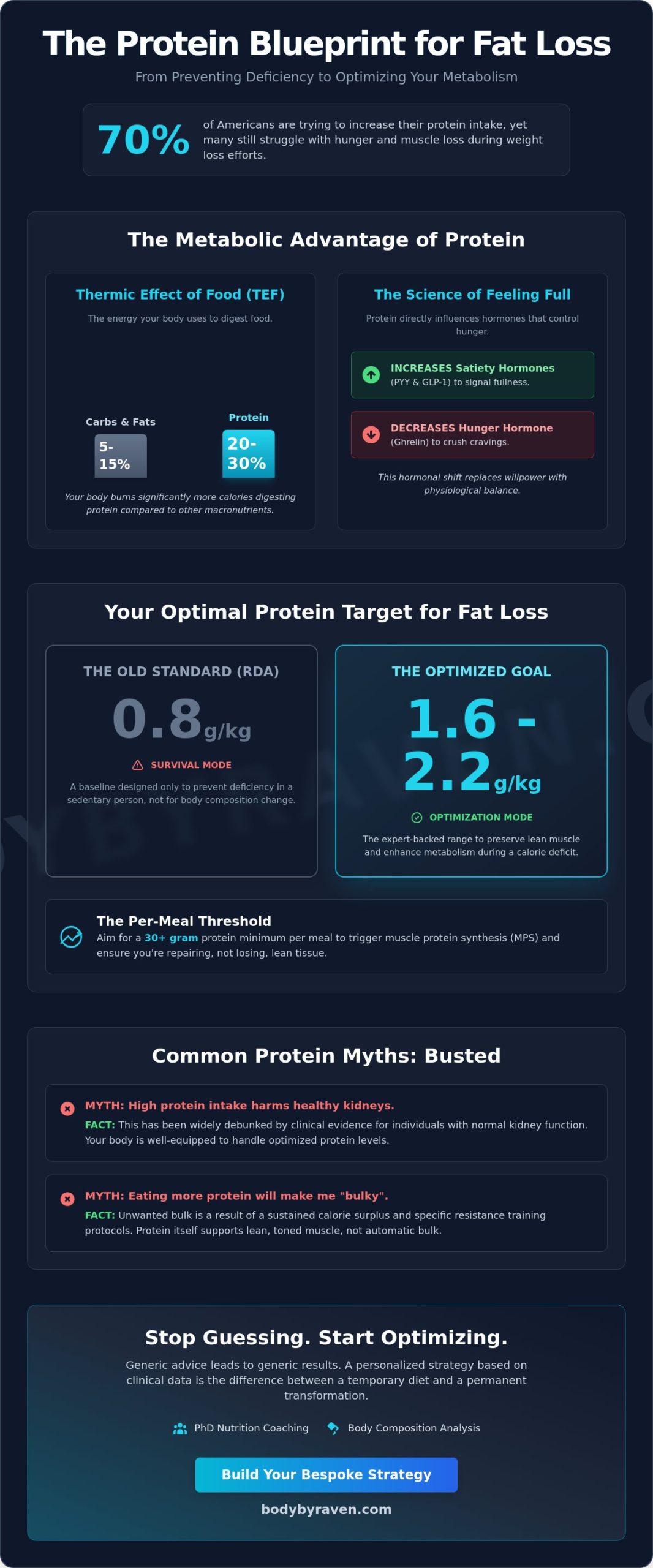
Digestion isn’t a passive process. It requires significant energy to break down the food you eat. The Thermic Effect of Food, or TEF, represents the energy your body spends to process nutrients. Not all calories are handled with the same efficiency. While fats and carbohydrates typically have a thermic rate between 5% and 15%, protein requires much more metabolic effort.
Clinical data shows that protein has a thermic rate of 20% to 30%. This means that for every 100 calories of protein you consume, your body uses up to 30 calories just to digest it. This built-in metabolic advantage supports a sustainable calorie deficit without the psychological strain of extreme restriction. You can explore the broader context of these nutritional strategies in this High-Protein Diet Overview.
Satiety and the Science of ‘Feeling Full’
Why do so many individuals struggle with cravings during a diet? The answer lies in hormonal regulation. Protein addresses this by directly influencing your endocrine system. It triggers the release of satiety hormones like Peptide YY (PYY) and Glucagon-like peptide-1 (GLP-1). These chemicals signal to your brain that you’re satisfied. At the same time, protein intake suppresses ghrelin, which is the hormone responsible for driving hunger signals.
This hormonal shift does more than just stop hunger. It helps stabilize blood sugar levels, preventing the insulin spikes that often lead to sugar cravings. When you consume high-protein meals, you naturally reduce the tendency for late-night snacking and impulsive eating. It’s a precise metabolic tool that replaces willpower with physiological balance. By choosing high-quality proteins, you’re investing in a strategy that works with your biology rather than against it.
How to Calculate Your Daily Protein Intake for Weight Loss
Most people rely on the Recommended Dietary Allowance (RDA) of 0.8 grams per kilogram of body weight. However, this figure is a baseline designed for sedentary survival and the prevention of basic deficiency. It isn’t a blueprint for physical transformation. When you’re in a calorie deficit, your body’s demand for amino acids increases significantly. Relying on outdated minimums often leads to the very muscle loss and metabolic slowdown we aim to avoid. To achieve superior results, we look toward the Science of Protein and Fat Loss, which suggests a more robust range of 1.6 to 2.2 grams per kilogram of goal body weight.
This higher protein intake for weight loss ensures that your body has a constant supply of the building blocks necessary to maintain lean tissue. If you’re highly active or facing a steep calorie deficit, aiming for the upper end of that range becomes essential. You should also consider your current body fat percentage. Individuals with more significant fat stores can often thrive at the lower end, while those seeking that final stage of definition require more precision to protect their existing muscle. Precision is the difference between a temporary diet and a permanent change.
Step 1: Determine Your Lean Body Mass
Your protein requirements are primarily driven by your lean tissue, not your fat mass. Fat is metabolically active, but it doesn’t require the same amino acid support that muscle does. To estimate your lean mass, you can subtract your estimated body fat percentage from your total weight. For example, a 200 pound individual with 25% body fat has 150 pounds of lean mass. While simple formulas provide a starting point, a professional body composition analysis offers the clinical accuracy needed for a bespoke nutrition plan. Knowing your exact numbers removes the guesswork from your journey.
Step 2: Apply the Fat-Loss Protein Multiplier
Once you have a clear picture of your lean mass or target weight, apply a multiplier of 0.8 to 1.2 grams per pound. This range allows for flexibility based on your lifestyle. If you participate in high-intensity resistance training or are nearing your goal weight, stay closer to 1.2 grams. This ensures your recovery keeps pace with your effort. To maximize these benefits, you must hit the protein threshold of approximately 0.3 grams per kilogram per meal to effectively trigger muscle protein synthesis. Distributing this total across 3 to 5 meals ensures your body remains in an anabolic state throughout the day. If you find these calculations overwhelming, a structured Weight Loss Program can simplify the process by providing a personalized roadmap tailored to your specific biology.
Protein Quality: Why Leucine and Amino Acid Profiles Matter
While hitting a total daily gram target is a necessary baseline, the specific amino acid profile of those grams determines whether your body remains in a muscle-preserving or muscle-wasting state. You can’t treat all sources as equals. Hitting your target protein intake for weight loss is only half the battle; if your sources lack the necessary amino acid diversity, your body cannot effectively signal for muscle repair. This often leads to the “skinny fat” phenomenon where the scale weight drops, but muscle tone and metabolic health vanish. Precision in your selection ensures that every calorie serves a functional purpose.
Leucine is the most critical of the branched-chain amino acids. It functions as a metabolic trigger. Without reaching a specific leucine threshold in a single meal, your body won’t initiate muscle protein synthesis, regardless of your total calorie count. This is why a “Ph.D. approach” focuses on the quality of each meal rather than just the daily total. By choosing high-quality sources, you maximize the efficiency of your metabolism and protect the lean tissue that keeps your resting heart rate and calorie burn high.
The Power of Leucine in Weight Loss
Think of leucine as the “master switch” for your physical transformation. To maximize the muscle-sparing effects of a calorie deficit, you need to hit a “leucine threshold” of roughly 2.5 to 3 grams per meal. This concentration is what actually “turns on” the cellular machinery required for tissue repair. High-quality sources like whey protein, lean beef, chicken, and soy are naturally dense in this amino acid. For those seeking clinical excellence, incorporating leucine rich foods into a structured meal plan is a cornerstone of professional nutrition coaching. It ensures your body isn’t just getting smaller, but also stronger and more metabolically resilient.
Plant-Based vs. Animal Proteins
Animal proteins are typically “complete,” meaning they contain all nine essential amino acids in the proportions your body requires. Plant-based options often have “limiting amino acids,” such as lysine or methionine, which can hinder the body’s ability to utilize the protein effectively. You can overcome this challenge through “protein layering.” This strategy involves combining different plant sources, such as grains and legumes, to create a complete amino acid profile.
One often overlooked factor in fat loss is the caloric trade-off associated with different protein sources. To get 30 grams of protein from a lean steak, you might consume 250 calories. To get that same amount from black beans, you would likely consume over 600 calories due to the high carbohydrate content. This makes animal-based proteins or highly refined plant-based isolates more efficient for individuals maintaining a strict calorie deficit. Understanding bioavailability and caloric density allows you to hit your targets without accidentally over-consuming other macronutrients.
Common Myths: Kidney Health, Bulking, and Protein Timing
Misinformation acts as a significant barrier to physical transformation. Many individuals hesitate to increase their protein intake for weight loss because of persistent urban legends that prioritize fear over physiology. These myths often circulate in public settings, creating unnecessary anxiety about a macronutrient that is essential for health. Utilizing science-based weight loss coaching in Naperville helps cut through this noise by providing evidence-based clarity. When you understand the clinical reality, you can pursue your goals with confidence rather than caution.
One of the most persistent myths involves the “anabolic window,” the idea that you must consume protein within thirty minutes of a workout. While post-exercise nutrition is beneficial, total daily protein intake for weight loss is a much stronger predictor of success than specific timing. Your body remains sensitized to amino acids for several hours after a session. Focus on your cumulative daily targets and the distribution of protein across all your meals. This steady supply is what truly protects your metabolic rate and lean tissue during a deficit.
Is High Protein Safe for Everyone?
Do high-protein diets damage the kidneys? For individuals with healthy renal function, clinical research consistently shows that higher protein levels are perfectly safe. The kidneys are highly adaptable and efficiently process and excrete excess nitrogen. There is, however, a clear distinction between healthy individuals and those with pre-existing renal disease. If you have a diagnosed kidney condition, your nutritional needs require specific medical oversight. For most adults, the only necessary lifestyle adjustment when increasing protein is a focus on hydration. Water is the primary vehicle for processing amino acids and maintaining internal balance. To ensure your nutrition plan is perfectly aligned with your health profile, consider a professional weight loss consultation to establish your baseline.
The ‘Bulky’ Misconception
Many people fear that a high-protein diet will lead to an unwanted, overly muscular appearance. This concern is biologically unfounded. Developing significant muscle mass requires a massive caloric surplus and specific, high-volume hypertrophy training. Protein alone cannot create “bulk” in a calorie deficit. Instead, it supports the firm, athletic look that many describe as “toning.” By preserving your existing muscle while fat is lost, protein ensures that your body composition improves as the scale moves down. This process is most effective when you combine high-quality nutrition with disciplined resistance training. Are you ready to stop guessing and start seeing measurable changes? Invest in a bespoke Weight Loss Program that prioritizes your long-term success.
Personalizing Your Strategy with Ph.D. Nutrition Coaching
Why do generic nutrition calculators often lead to frustration? Most online tools offer a static snapshot of your needs, failing to account for the dynamic nature of your metabolism. As you progress through a weight loss journey, your body undergoes metabolic adaptation. This means your requirements for protein intake for weight loss will shift as your body composition changes. Relying on an automated app or a one-size-fits-all percentage ignores these nuances, often leading to stalled progress and muscle loss. Professional nutrition coaching provides the precision needed to adjust your plan based on real-time data and metabolic tracking.
Private coaching offers a level of accountability that digital platforms cannot replicate. It provides the mental focus and direction necessary to stay disciplined when challenges arise. At Body by Raven LLC, we view transformation as a comprehensive process. We don’t just hand you a meal plan; we partner with you to ensure every aspect of your lifestyle supports your goals. This boutique approach is designed specifically for Naperville residents who value clinical rigor and professional expertise over aggressive marketing tropes. If you’ve struggled with generic templates and conflicting advice in the past, a dedicated weight loss service built on PhD-led precision can provide the sustainable transformation that one-size-fits-all programs simply cannot deliver.
The Advantage of Private Personal Training
Integrating nutrition and movement is the only way to achieve true body recomposition. Working with a private personal trainer Naperville specialist provides a controlled, supportive environment where you can master the mechanics of resistance training. This private setting is essential for building confidence, especially for individuals ready for a significant lifestyle change. Dr. Raven Flores utilizes her Ph.D. in kinesiology to ensure that your training sessions are as scientifically sound as your nutrition. This level of expertise ensures that your efforts in the gym directly support the muscle-preserving signals sent by your protein intake for weight loss.
Taking the Next Step in Your Journey
Moving from “dieting” to scientific body recomposition requires a fundamental shift in mindset. It’s about moving away from the scale as the only measure of success and looking toward Body Composition Analysis to track your actual health. You don’t have to navigate these complex variables alone. Professional guidance replaces uncertainty with a feeling of professional resolution. If you’re ready to move beyond generic calculators and start a personalized Weight Loss Program, the next step is a professional assessment. Invest in a partnership that prioritizes your longevity and metabolic health through clinical precision and a bespoke roadmap tailored to your life.
Take Control of Your Metabolic Future
Mastering your protein intake for weight loss is a fundamental step toward achieving the athletic, toned physique you’ve worked for. You now understand that protein serves as a critical metabolic signal, protecting your lean tissue while the thermic effect of food accelerates fat loss. By prioritizing high-leucine sources and distributing your intake across the day, you’ve moved beyond the limitations of generic dietary advice. This scientific approach replaces the frustration of temporary results with the clarity of professional body recomposition.
Sustainable success requires more than a static plan; it demands the clinical precision of bespoke nutrition and kinesiology integration. In our private, boutique coaching environment, we eliminate the guesswork and focus on your unique metabolic needs. Are you ready to stop guessing and start seeing the results your discipline deserves? Schedule Your Ph.D.-Led Weight Loss Consultation in Naperville Today and partner with Dr. Raven Flores, Ph.D., at Body by Raven LLC to build a healthier, more confident future. You’ve done the research. Now it’s time for action.
Frequently Asked Questions
Can you eat too much protein while trying to lose weight?
Consuming too much protein is possible because every gram contains four calories that contribute to your total daily energy balance. While it’s difficult to overeat protein due to its high satiety, any caloric surplus will eventually lead to fat storage. For most healthy individuals, the primary concern with excessive protein isn’t a health risk, but rather the accidental displacement of essential fiber and healthy fats from the diet.
What are the best high-protein snacks for weight loss?
The most effective high-protein snacks for weight loss are whole-food options that offer high satiety with minimal processing. Greek yogurt, cottage cheese, and hard-boiled eggs are excellent choices that help you maintain a consistent protein intake for weight loss between your primary meals. These options provide the essential amino acids needed to signal muscle preservation without the hidden sugars often found in commercial protein bars or processed snacks.
Do I need protein shakes, or is whole food better?
Whole foods are generally the better choice because they provide greater satiety and a more complex profile of vitamins and minerals. Protein shakes are a helpful supplement when your schedule makes it difficult to sit down for a complete meal. They’re a convenient tool for hitting your daily targets, but they shouldn’t replace the structural and metabolic benefits of solid, nutrient-dense protein sources that require more energy to digest.
How much protein should a woman eat to lose weight compared to a man?
Your specific protein needs are based on your lean body mass and activity level rather than your gender. While men often require more total grams because of their larger physical frames, the recommended ratio of 1.6 to 2.2 grams per kilogram of goal weight applies to both men and women. This personalized approach ensures that everyone receives the precise amount of amino acids required to protect their metabolism during fat loss.
Will a high-protein diet work without exercise?
A high-protein diet will improve satiety and increase your metabolic rate through the thermic effect of food, but it’s less effective without resistance training. Exercise provides the necessary stimulus to tell your body to keep its muscle and burn its fat. To see the best results in body composition, you should pair your nutrition coaching with a structured weight loss program that includes regular physical activity.
What happens if I don’t eat enough protein during a calorie deficit?
If you fail to consume enough protein during a calorie deficit, your body will likely begin to break down its own muscle tissue for energy. This loss of lean mass leads to a slower metabolism and often results in increased hunger and persistent cravings. You might see the scale move down, but your body composition will likely suffer, making it much harder to keep the weight off long-term.
How do I track my protein intake accurately?
Tracking your intake accurately involves using a digital food scale to weigh your portions in grams rather than relying on visual estimates. Volume-based measurements are often inaccurate and can lead to significant errors in your daily calorie and macronutrient counts. Using a verified nutritional database allows you to log your meals precisely, providing the data your coach needs to refine your bespoke nutrition and training strategy.
Is it better to eat more protein in the morning or at night?
It’s most beneficial to distribute your protein intake evenly throughout the day rather than saving it for a single large meal. Starting your day with a high-protein breakfast helps stabilize your blood sugar and suppress hunger hormones like ghrelin from the outset. This consistent supply of amino acids ensures that your protein intake for weight loss remains optimized for muscle protein synthesis from your first meal to your last.







Leave a Reply